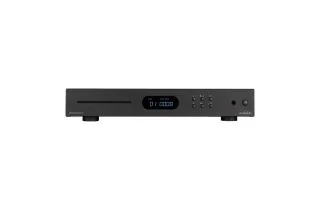
3000CD
The Audiolab 3000CD is our first new dedicated CD player in more than a decade. Designed as the perfect partner to the newly announced 3000A integrated amplifier, the 3000CD marks Audiolab’s return to the complete-player format at a very accessible price point.
Much like the 3000A amplifier, the 3000CD is not a generic disc mechanism paired with a convenient DAC to create a basic playback solution. Its mechanism, servo control, power architecture, conversion stage and analogue output bring Audiolab’s engineering pedigree together in one source component, developed around the complete journey from the disc surface to the amplifier's input.
Focus by Design
Like the 3000A, the 3000CD controls cost through focus. It does not attempt to become a network player, storage server or universal digital hub. Its principal task is CD replay, supported by carefully selected digital inputs that extend the value of its onboard DAC. This disciplined brief allows the engineering and component value to remain concentrated on the parts that determine how reliably the disc is read and how convincingly the recovered data becomes music.
The compromise is in the breadth of the feature list, not in the seriousness of the replay chain. For a first separates system, that is a meaningful distinction: buy the functions that are needed, invest in the quality that will continue to matter and leave the system free to grow in the listener’s own direction.
The 3000CD draws on Audiolab’s experience in CD mechanisms, servo-control architecture and core power-supply design. Here, those transport principles are applied to a different system brief: a complete player with its own digital-to-analogue conversion, designed to make high-quality disc replay easier to own and simpler to connect.
Servo Precision in Motion
The servo is the control system behind stable disc replay. It manages spindle speed, maintains laser focus and tracking, and responds to the physical variations encountered during playback. A well-integrated servo does this work accurately and unobtrusively, allowing error detection and correction to operate from a stable reading environment rather than constantly compensating for avoidable mechanical uncertainty.
Audiolab’s approach treats the mechanism, servo and decoding stages as one coordinated system. The customer benefit is simple: dependable access to the music, consistent reading across a real-world disc collection and a digital signal presented to the DAC from a controlled foundation.
Control Before Conversion
A DAC can only work with the signal it receives. The 3000CD therefore begins its performance story before digital-to-analogue conversion, with the mechanical control and data recovery required to keep the source stable. The onboard DAC is not used to disguise a basic transport stage; it completes a replay chain whose first priority is to read the disc properly.
The Power Behind the Source
Power-supply design matters in a CD player because its internal demands are varied. Motors and servo circuits operate dynamically, digital logic switches at high speed, and the DAC and analogue output require stable, quiet conditions. Treating all of these demands as one generic load risks allowing one section to disturb another.
The 3000CD uses a custom-specified transformer as the foundation of its power architecture. Rather than choosing a transformer only by headline rating, Audiolab specifies it for the electrical behaviour of the complete player. The surrounding supply design supports the mechanism and servo while providing the controlled conditions needed by the digital and analogue stages.
This is an important part of the 3000CD proposition. At an accessible price, a generic external supply might have been the easier choice. Audiolab instead keeps the power foundation inside the product and makes it part of the engineering brief, helping the player behave as a coherent hi-fi component rather than a collection of modules.
Conversion Is More Than a Chip
Once the disc data has been recovered, the ESS Sabre ES9018K2M converts it for the analogue system. This is a high-performance 32-bit stereo DAC based on ESS HyperStream architecture, with the low-distortion capability and jitter-management technology that have made Sabre devices a familiar part of Audiolab’s digital history.
The DAC name is only the beginning. The final result depends on power regulation, clock behaviour, circuit layout and the analogue stage that follows conversion. Audiolab’s role is to turn the capability of the silicon into the balanced, open and controlled presentation expected of the brand, so that the 3000CD sounds like an Audiolab source rather than simply a product containing an Audiolab-approved component.
A Complete Player, Not Just a Transport
A dedicated CD transport sends the recovered digital signal to an external DAC. That remains the right solution for listeners who have already chosen a separate conversion stage. The 3000CD serves a different need. By integrating the ES9018K2M and analogue outputs, it can connect directly to the 3000A or another analogue amplifier and form a complete source-to-loudspeaker system with fewer boxes and cables.
That simplicity is not the same as an all-in-one compromise. The source and amplifier remain separate, each with a focused role and its own power supply. The listener gains the clarity and upgrade freedom of separates without having to purchase an external DAC at the beginning of the journey.
Digital Extension
The 3000CD extends the value of its onboard conversion stage beyond compact disc. USB-C, optical and coaxial S/PDIF inputs allow computers, streaming transports, televisions, games consoles and other compatible digital sources to access the same ES9018K2M conversion and Audiolab-designed analogue output stage.
This is particularly valuable in a system built around the analogue-focused 3000A. Rather than relying on the basic conversion circuitry contained in each source device—or adding a separate external DAC—the listener can route multiple digital sources through one carefully implemented Audiolab conversion stage. The result is a simpler system, more consistent performance between sources and far greater flexibility as listening habits develop.
The USB-C, optical S/PDIF and coaxial S/PDIF inputs support PCM audio up to 24-bit/192kHz. CD remains central to the product’s identity, while these additional inputs make fuller use of the high-quality DAC already inside it. The 3000CD therefore becomes the digital gateway to an accessible Audiolab separates system without turning either the player or amplifier into an overloaded digital platform.
Designed for the 3000A
The 3000CD and 3000A divide system responsibilities clearly. The player reads the disc, accommodates compatible external digital sources and performs digital-to-analogue conversion; the amplifier concentrates on analogue signal control, phono replay and loudspeaker drive. Together, they form an accessible Audiolab separates system in which cost is controlled through purpose—not by asking a single component to perform every possible function.
Although the 3000A is its natural partner, the 3000CD is designed to feel at home across the wider Audiolab ecosystem too. Its industrial design follows the same understated visual language as the 6000, 7000 and 9000 Series, while its carefully implemented ES9018K2M DAC and analogue output stage give it the performance to partner more ambitious amplifiers. The 3000CD can therefore begin as the source in an accessible 3000 Series system and remain a relevant, rewarding component as the system develops through the Audiolab range.
A System with Room to Grow
The flexibility extends beyond amplifier choice. Loudspeakers, amplification and other source components can develop around the 3000CD, while the player continues to provide direct access to CD and compatible digital sources.
It helps make the first system attainable, while its focused engineering allows it to remain useful as that system becomes more ambitious.
The Audiolab 3000 Series begins with a simple proposition: real hi-fi should be accessible, focused and rewarding from the first system. The 3000A gives that system its analogue heart. The 3000CD gives an existing collection a new reason to be heard.