

Victrola
Victrola
Victrola's story begins in 1901, when inventor Emile Berliner, creator of the flat-disc gramophone, contracted engineer Eldridge R. Johnson to manufacture spring-driven motors for his design. Johnson went on to found the Victor Talking Machine Company that same year, and in 1906, in Camden, New Jersey, the company unveiled its landmark invention: a phonograph with the horn folded downward into an elegant floor-standing cabinet, hiding the once-obtrusive horn entirely and transforming the record player into a genuine piece of furniture. That innovation was patented under a new name — Victrola — and it quickly became a genuine status symbol in American homes.
Backed by the now-iconic "His Master's Voice" trademark and luxurious cabinet craftsmanship, Victor became the largest and most successful phonograph manufacturer of its era, producing over 8.2 million Victors and Victrolas between 1906 and 1929 alone. The company later became part of RCA, and more than a century later, the Victrola name was revived in the United States by Innovative Technology, bringing the same spirit of nostalgic design and quality craftsmanship to a new generation.
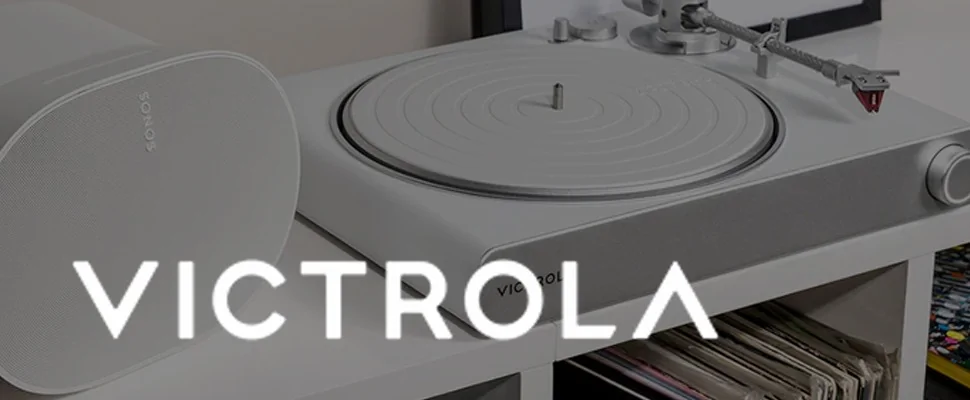
Today Victrola builds turntables spanning vintage-inspired suitcase players to high-fidelity Bluetooth-enabled belt-drive decks, alongside complete audio systems including bookshelf speakers. More than 100 years after Eldridge Johnson first hid a phonograph horn inside a wooden cabinet, Victrola remains dedicated to the same idea: music deserves to be enjoyed beautifully, not just heard.